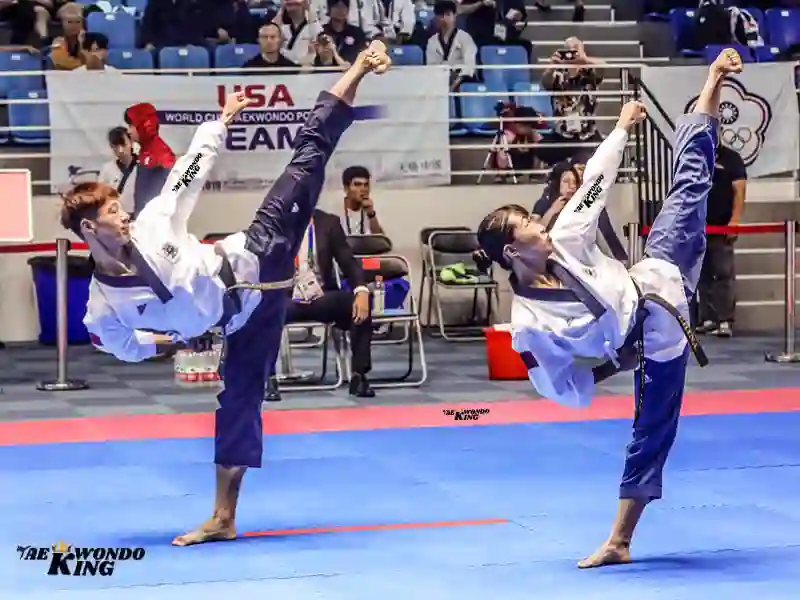
TaekwondoPoomsae
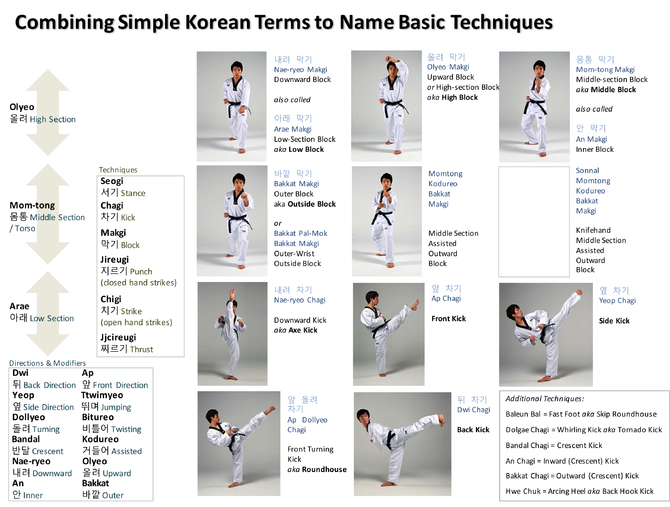
Taekwondo Poomsae (품새) are formal patterns of Taekwondo techniques consisting of blocks, strikes, stances, kicks, and movements performed in a fixed sequence. They represent a fight against imaginary opponents and are used to develop technique, balance, coordination, power, breathing control, and focus. (ilgitaekwondo.org) Main types of Kukkiwon/WT Poomsae 1. Taegeuk Poomsae (태극 품새) – Color Belt Forms Taegeuk forms are the foundation forms learned before black belt. There are 8 Taegeuk Poomsae: Taegeuk Il Jang (1) Taegeuk Yi Jang (2) Taegeuk Sam Jang (3) Taegeuk Sa Jang (4) Taegeuk Oh Jang (5) Taegeuk Yuk Jang (6) Taegeuk Chil Jang (7) Taegeuk Pal Jang (8) (taekwondo.fandom.com) 2. Yudanja Poomsae (Black Belt Forms) These are advanced forms for Dan (black belt) ranks, including: Koryo Keumgang Taebaek Pyongwon Sipjin Jitae Chonkwon Hansu Ilyeo (globalmartialarts.university) Purpose of practicing Poomsae Improve correct technique and body mechanics Build speed, strength, and accuracy Practice transitions between movements Develop mental discipline and concentration Prepare for belt examinations and competitions (ilgitaekwondo.org) If you mean Taekwondo Poomsae list by belt level, Poomsae competition rules, or step-by-step movements of a specific Poomsae (e.g., Taegeuk 1 Jang), I can provide that too. Here is a more detailed explanation of Taekwondo Poomsae (품새), including history, structure, meanings, and training methods. What is Poomsae? Poomsae is a structured sequence of Taekwondo movements performed according to a fixed pattern. Each movement represents a defensive or offensive technique against imaginary opponents. The word is often explained as: Poom (품) – form, shape, or quality of technique Sae (새) – appearance, style, or arrangement Poomsae combines physical skill with mental discipline. A good performance requires correct technique, timing, balance, power, breathing, and concentration. Structure of a Poomsae A Poomsae usually contains: 1. Stances (Seogi) Examples: Ap Seogi – Walking stance Ap Kubi – Front stance Dwit Kubi – Back stance Juchum Seogi – Horse stance Beom Seogi – Tiger stance Correct stance provides stability and allows powerful techniques. 2. Blocks (Makgi) Examples: Arae Makgi – Low block Momtong Makgi – Middle block Eolgul Makgi – High block Sonnal Makgi – Knife-hand block 3. Strikes and Punches Examples: Momtong Jireugi – Middle punch Eolgul Jireugi – High punch Sonnal Chigi – Knife-hand strike 4. Kicks (Chagi) Examples: Ap Chagi – Front kick Dollyo Chagi – Roundhouse kick Yop Chagi – Side kick Taegeuk Poomsae (Color Belt Forms) The eight Taegeuk forms represent the eight trigrams (Palgwae) from traditional Korean philosophy. Each form increases in difficulty. Taegeuk Il Jang (1st Form) Symbol: ☰ Heaven (Keon) Focus: Basic stances Basic blocks Straight punches Meaning: Beginning, creation, and the start of learning. Taegeuk Yi Jang (2nd Form) Symbol: ☱ Lake (Tae) Focus: Better balance More coordinated movements Introduction of kicking techniques Taegeuk Sam Jang (3rd Form) Symbol: ☲ Fire (Ri) Focus: Stronger attacks Knife-hand techniques Faster combinations Taegeuk Sa Jang (4th Form) Symbol: ☳ Thunder (Jin) Focus: Back stance Knife-hand blocks More complex transitions Taegeuk Oh Jang (5th Form) Symbol: ☴ Wind (Son) Focus: Strong movements Side kicks Controlled power Taegeuk Yuk Jang (6th Form) Symbol: ☵ Water (Gam) Focus: Advanced footwork Balance after kicks Smooth movement Taegeuk Chil Jang (7th Form) Symbol: ☶ Mountain (Gan) Focus: More advanced stances Precision and control Taegeuk Pal Jang (8th Form) Symbol: ☷ Earth (Gon) Focus: Preparation for black belt Combining all previous skills Black Belt Poomsae Koryo (고려) Represents the spirit of the Korean dynasty of the same name. Focus: Strong techniques Confidence Warrior spirit Keumgang (금강) Means “diamond” or something strong and unbreakable. Focus: Power Stability Mountain-like strength Taebaek (태백) Named after a sacred Korean mountain. Focus: Precision Clear and powerful movements Pyongwon (평원) Represents a wide, peaceful plain. Focus: Calmness Balance Control Sipjin (십진) Based on the idea of longevity and the decimal system. Focus: Stability Advanced techniques Jitae (지태) Represents earth and the connection between humans and nature. Chonkwon (천권) Represents the sky and great energy. Hansu (한수) Represents water and adaptability. Ilyeo (일여) Represents unity of mind, body, and spirit. Poomsae Competition Scoring In official competitions, judges generally evaluate: Accuracy Correct stances Correct techniques Correct sequence Presentation Power Speed Rhythm Balance Expression of energy Important performance points: Start and finish at the same position Maintain correct breathing Avoid unnecessary movement Show confidence and control How to Practice Poomsae Better Learn the pattern slowly first Accuracy comes before speed. Practice each movement separately Perfect blocks, punches, and stances individually. Use correct breathing Exhale during powerful techniques. Focus on transition Moving between techniques smoothly improves the overall performance. Train both sides Develop equal strength and coordination. Practice with intention Imagine real opponents and apply each technique with purpose. Poomsae is not only a memory exercise; it is a way to develop technical skill, discipline, confidence, and martial awareness in Taekwondo.